From 384 kbps to Claude Code: Why the Era of the Hyper-Specialized Developer is Over
How the evolution of AI-powered development tools is collapsing traditional tech boundaries, shifting engineering leverage from hyper-specialized silos to versatile generalists.
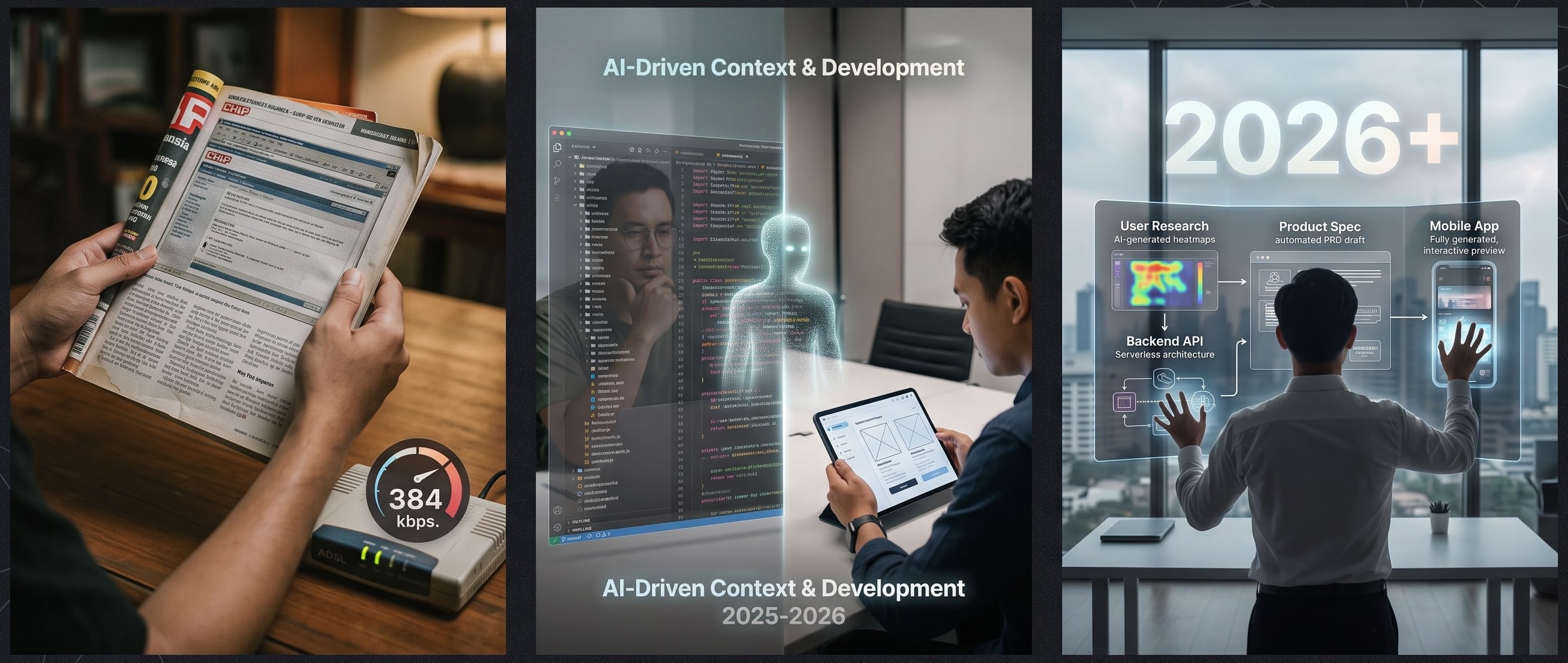
Back in 2010, software was starting to ramp up globally, and I saw an incredible potential for digital technology to transform and modernize the physical world. At the time, we were witnessing a massive growth spurt in hardware, the internet, and web applications. Yet, even as an optimist, I never imagined platforms like Facebook would become as advanced as they are today—serving billions of users and seamlessly integrating countless third-party plugins.
Back then, most websites were little more than simple forums where people gathered to chat. In Indonesia, our connection to this digital frontier was slow, dragging along at a mere  . But my passion for technology kept me hooked. I did whatever I could to stay updated, even reading physical tech magazines just to know what was happening on the other side of the world.
When I graduated with a degree in electrical engineering, my confidence in software grew. I realized that if I could build expertise at the intersection of hardware and software, I would have the ultimate toolkit to build a career for life.
The Era of Extreme Specialization
When I joined my first tech company, I began to truly understand the highly segmented world of modern software development. I learned the distinct boundaries between roles:
- Frontend Developers
- Backend Developers
- Mobile Developers
- QA Engineers
- Product Managers
- UI/UX Designers
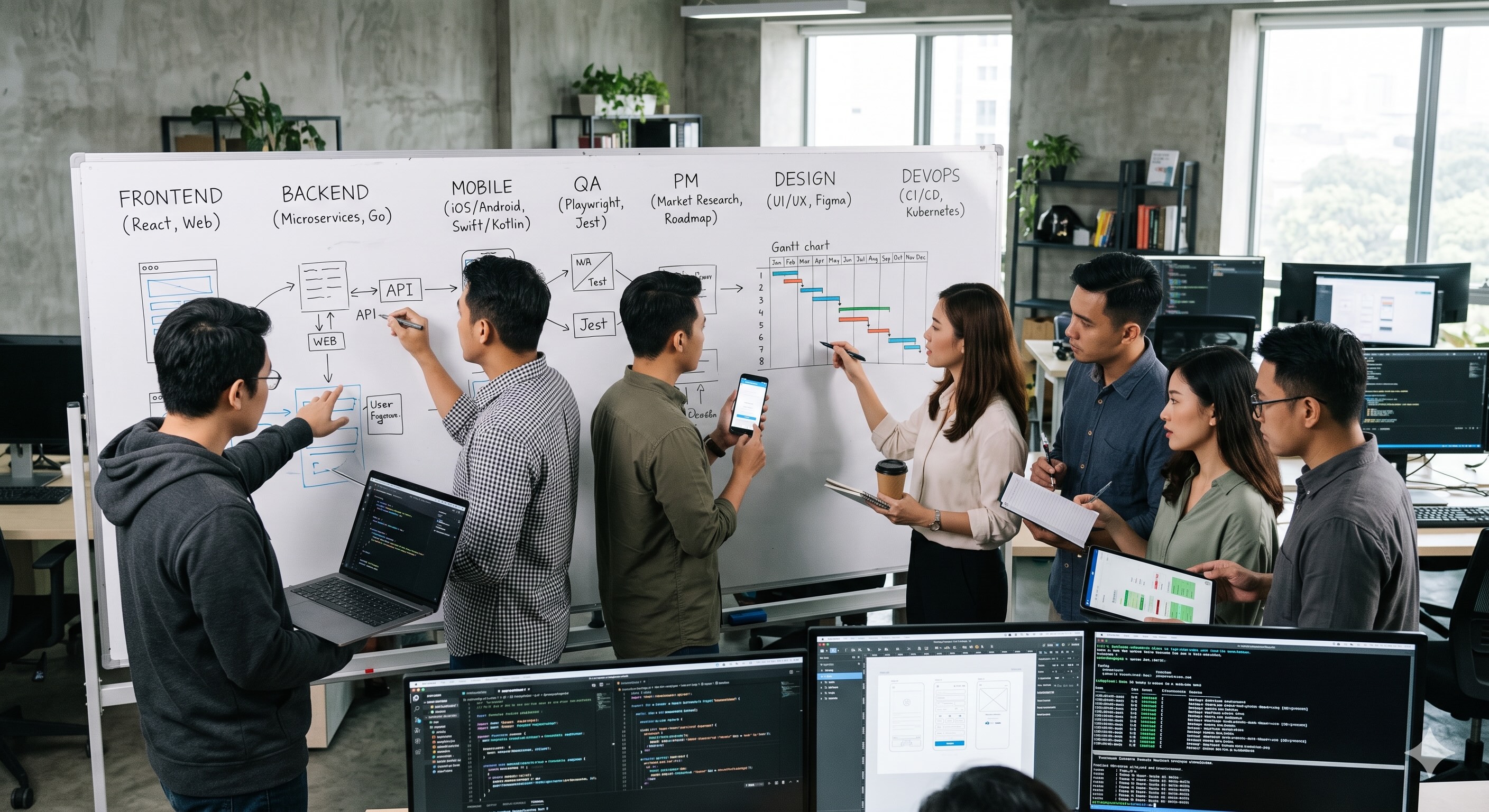
As the industry matured, these roles became incredibly specialized. Tech was growing relentlessly, and companies everywhere realized that digital infrastructure was no longer optional—it was the mandatory engine required to scale a business. To keep up, we divided the labor into highly specific silos.
For decades, Artificial Intelligence existed in the background of this evolution, but it was highly rigid. It could only help humans with very narrow tasks and lacked the flexibility to be integrated easily into diverse software ecosystems. AI back then was a game bot, a basic Google Translate tool, or a crude speech-to-text transcriber. I still remember when the absolute pinnacle of AI achievement was a chess engine beating a world champion.
Then, ChatGPT was released to the public, and everything changed.
The Shift: From General Answers to Full Context
Even though ChatGPT's early knowledge was strictly limited to its training data, its ability to understand and parse natural language was beyond my comprehension. Within months, competing Large Language Models (LLMs) from every major tech giant emerged. I watched in amazement as Midjourney generated stunning imagery, and LLMs wrote short helper scripts that allowed me to bypass syntax roadblocks in almost any programming language.
Yet, during the 2024–2025 window, AI still felt somewhat distant. It lived outside our active workflows. Because it lacked local context, it often returned generic answers. I remember thinking that our tech jobs were still relatively safe.
That perspective shattered in the second half of 2025 with the rise of agentic tools like Cursor.
Suddenly, we had coding agents capable of understanding the entire context of a local codebase. AI could now follow specific coding guidelines, debug complex issues, and help integrate systems across a company's entire repository. This was the turning point. AI transitioned from a novelty search box into an active partner.
I suddenly found myself ignoring my own language barriers. If I needed to write code in a framework I had rarely touched, the AI handled the heavy lifting, outputting high-quality code that adhered to best practices. Around me, every role was trying to squeeze maximum utility out of these tools. Yet, the transition was still relatively slow because people without a technical foundation struggled to prompt the AI effectively.
2026: The Collapse of Boundaries
Now, in the first half of 2026, the ecosystem has fully matured. AI doesn't just look at a single file; it understands entire system contexts.
More importantly, the developer tools themselves are evolving to be AI-friendly:
- In QA: Testing frameworks like Playwright can now extract web elements directly in highly structured YAML formats, making it incredibly easy for an AI to parse and test, rather than forcing it to wade through messy, bloated HTML DOM trees.
- In Product Design: Tools like Claude Code now feature powerful design capabilities, allowing anyone to generate consistent, high-fidelity mockups of a product in seconds.
- In Engineering: Programming languages and platforms are no longer rigid boundaries. Because AI lives locally on our machines with access to our entire workspaces, we can build across the stack effortlessly.
This brings us to an undeniable reality: AI is highly empowering, but it is actively rewriting the tech career path.
The days of being strictly a "backend developer," a "mobile developer," or a "product manager" are drawing to a close. Today, a single professional can access the deep contextual knowledge that used to take years of specialized exposure to acquire.
For example, a traditional Product Manager’s strength lies in user and market research. Today, an AI possesses a massive baseline of general market dynamics. By feeding it your specific business context, a single builder can get product insights that rival or exceed what a dedicated PM could deliver years ago. Similarly, a backend engineer no longer needs years of mobile experience to deploy a native app; the AI ensures the mobile project structure, state management, and architecture follow industry-standard best practices from day one.
The Return of the Generalist
I believe we are rapidly moving toward a major consolidation. Tech roles will soon merge into highly versatile generalist positions, mirroring the "one-man-band" web master roles of the early 2000s, but with superpower-level leverage.
There is no longer any benefit to being idealistic or stubborn about a single domain. To stay valuable, you must understand the entire lifecycle of a product:
- How to conduct product and market research.
- How a business model is executed and monetized.
- How to design and build the backend, frontend, and mobile clients.
- How to test, deploy, and maintain the infrastructure.
Those who master the art of directing AI to execute these tasks will be the undisputed winners of this era.
| Dimension | The Era of Specialization (Pre-2025) | The AI-Augmented Generalist (2026+) |
|---|---|---|
| Core Leverage | Deep expertise in a single silo (e.g., Backend, QA, UI/UX) | System orchestration and product lifecycle context |
| Tooling Interface | Command lines, IDEs, manuals, manual configuration | Context-aware agentic tools (e.g., Cursor, Claude Code) |
| Role Boundary | High division of labor; rigid handoffs between teams | Fluid building across the stack (frontend, backend, mobile) |
| Skill Breadth | Narrow & deep (T-shaped vertical specialization) | Broad & systemic (full-lifecycle capability) |
| Speed to Market | Days/weeks for cross-team alignment and deployment | Hours/days for a single developer to build and test |
The One Caveat: The Cost of Intelligence
Is there a scenario where human specialization claws back its ground? Perhaps. The only major bottleneck I foresee is the sheer economic cost of computing. If running these hyper-advanced reasoning models becomes prohibitively expensive, companies may find themselves forced to rely on human labor to bridge the gap.
But until that day comes, the directive is clear.
My advice to you: Do not wait. Start building your expertise as an AI-augmented generalist today. Learn to orchestrate these tools across multiple disciplines, and you will secure your place in the market for the years to come.